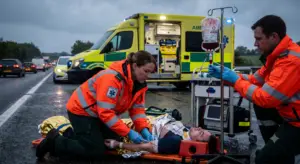
NEJM: Prehospital Resuscitation with Type O Whole Blood for Trauma and Hemorrhage
Jason L Sperry 1, Francis X Guyette 2, Bryan A Cotton 3, James F Luther 4, Richard B Utarnachitt 5, Matthew E Kutcher 6, Brian J Daley 7, Allan B Peetz 8, Mayur B Patel 8, Michael D Goodman 9, Jeffrey A Claridge 10, Nimitt Patel 10, Brian G Harbrecht 11, Zain G Hashmi 12, Ryan Zarychanski 13, Matthew D Neal 1, Mark H Yazer 14, Christian Martin-Gill 2, Laura E Vincent 1, Ashley M Harner 1, David E Meyer 3, Andrew J Latimer 5, Bryce R Robinson 15, Catherine L McKnight 7, William R Hinckley 9, Keith R Miller 11, Jan
Save Don’t Swap: Just Use EMS Equipment in OHCA?
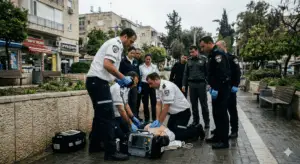
Written by Ketan Patel Spoon Feed This hypothesis-generating study showed that maintaining EMS pads and equipment during ED transfer for out-of-hospital cardiac arrests (OHCA) saved 143 seconds to first rhythm analysis and defibrillation. Stay and play? With EMS equipment at least… Prior work has classically taught us that every minute
EMA: Cervical Spine Immobilisation Following Stab Wounds to the Neck Is Unnecessary
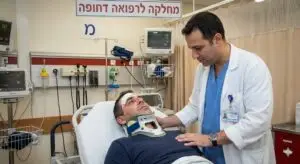
Leon Kong, Victor Kong, Jonathan Ko, Howard Wain, Jim Wang, Jonah Qi, John Bruce, Grant Laing, Damian Clarke ABSTRACT Objective This study reviews our experience with penetrating neck injury (PNI) secondary to a stab wound (SW) to clarify the incidence of cervical spinal injury (CSI) and to interrogate the role of cervical

ECG Teaching Cases: Reluctantly Reaching for the Probe
***It’s no secret that ultrasounds are not my biggest strength. When I run into trouble with complicated Echos I turn to my friend and echocardiography guru Aram, who is part of the team who writes the “The Echo Journal” This week, we dive into a complicated patient with an interesting finding
PODCAST: Pre-Hospital Whole Blood with Dr. Scott Branney
Recorded at the Colorado ACEP High Risk: Do Not Miss Conference in Beaver Creek, this episode of ACEP Frontline features Dr. Ryan Stanton and a presentation by Dr. Scott Branney on a growing trend in trauma and resuscitation, prehospital whole blood. As more EMS systems adopt whole blood programs, the

JAMA: Sodium Bicarbonate for In-Hospital Cardiac Arrest A Randomized Clinical Trial
Asger Granfeldt, MD, PhD, DMSc1,2; Bertram Lahn Kirkegaard, MD1,2,3; Mikael Fink Vallentin, MD, PhD1,2,3 et al Author Affiliations Cite Permissions Metrics Key Points Question Does sodium bicarbonate administered during in-hospital cardiac arrest improve return of spontaneous circulation? Findings In this randomized clinical trial that included 779 patients with in-hospital cardiac arrest in Denmark, the proportion of patients who achieved return
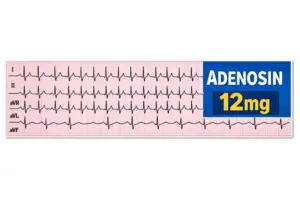
Initial 12mg Versus 6mg Adenosine for Supraventricular Tachycardia in the Emergency Department
Ekrem Taha Sert 1, Kamil Kokulu 1, Oğuz Yürük 1, Emin Hüseyin Akar 1, Muhammed Ali Topuz 1 Affiliations Expand Abstract Objectives: This study aimed to compare the efficacy and safety of an initial 12 mg versus 6 mg adenosine dose for sinus rhythm conversion in patients presenting with supraventricular tachycardia (SVT) in the emergency department (ED). Methods: This prospective observational study
ECG Teaching Cases: She's Shaking; It Must be a Seizure!
“Hey, can I staff the patient in bed 12 with you? This one is a little strange.” You hear your intern ask the senior resident. “Sure!” She says, “What’s going on with your patient?” “Well. He’s a 95-year-old male coming in with a first-time seizure today.” The intern starts. “WHAT? I’m going to
