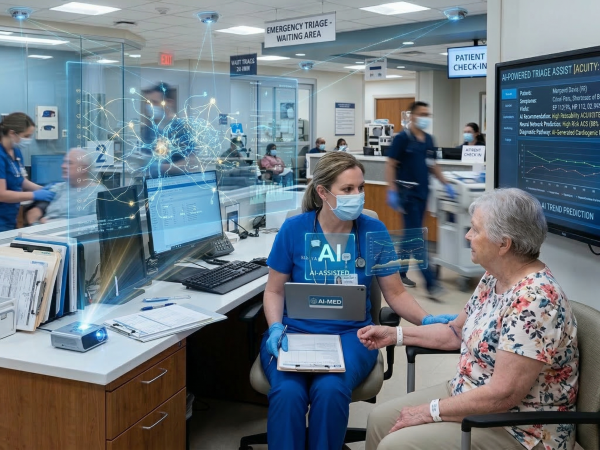

Using an ambient AI scribe while he’s seeing patients “has brought more joy into the practice of medicine,” said Ken Milne, MD, a staff emergency physician at Strathroy Middlesex General Hospital in Strathroy, Ontario, Canada, who began using the technology a year ago. “It allows me to practice the art and let the AI do the grunt work.” Because he no longer has to worry about jotting down notes while talking to patients, he is able to be “more present,” he said. “I feel less like an expensive data entry clerk.”
Explore This Issue

Dr. Milne
Many emergency physicians that ACEP Now spoke to for this story share Dr. Milne’s opinion: Using an AI scribe makes work in the emergency department (ED) easier, even if ambient AI scribes aren’t yet at the point where they shave much time off of making patient records. A new study, published this month in Annals of Emergency Medicine,” found that AI scribes save emergency physicians only 1.6 minutes of documentation work per patient, compared to 3.3 minutes for human scribes. But Dr. Milne argued that for physicians like him who didn’t have any kind of note-taking assistant, computerized or human, before ambient AI became available, every minute saved counts. “It could be ‘clinically significant’ to the well-being of the physician,” he said. “That 90 seconds might let me go to the washroom or make a coffee.”

Dr. Dutta
The lead author of the new study has a similar take: AI scribes feel good, even if the good feelings may not be easy to quantify. “It feels better to get back to your computer and see a drafted note and not a blank page,” said Sayon Dutta, MD, MPH, an associate professor of emergency medicine at Harvard Medical School and Massachusetts General Hospital. “Ambient reduces cognitive burden, and if that cognitive effort can be directed to more face-to-face patient time, deeper chart review, or teaching of residents, these are tangible benefits that are hard to measure,” Dr. Dutta added.
Another physician, who has no connection to the new study, similarly said that easing the burden on emergency physicians, even incrementally, is important. “Documentation fatigue is a real driver of attrition in emergency medicine, and anything that meaningfully reduces it has clinical value downstream,” said Jason Adler, MD, clinical associate professor at the University of Maryland Medical Center and School of Medicine, who has studied the academic literature on the topic of AI scribes in the ED and lectured widely about it.

Dr. Adler
Most emergency physicians familiar with the topic also point out that as AI scribes continue to be fine-tuned for use in medical settings, they will improve in ways that will further decrease demands on time and attention. For instance, AI scribes aren’t good yet at distinguishing who is speaking when multiple people are talking at the same time, and the ED provides special challenges. “The ED is loud, and noise contamination can degrade the ability for ambient to hear what’s going on and make a robust audio transcript to summarize,” said Dr. Dutta. “Sometimes providers forget to stop a recording or are interrupted by a midlevel or nurse about a different patient, and ambient then attributes that conversation to the wrong patient.” Such inaccuracies can prove significant. “If someone says, ‘chest pain,’ and ambient can’t figure out if it’s the provider or the patient, ambient might construe it as a question rather than a symptom or vice versa,” Dr. Dutta pointed out.
Another significant category of error for the current generation of ambient AI scribes: Missing — or “not hearing” — something important that someone has said. Such omissions are difficult for a physician to recognize, as Dr. Adler pointed out. “When content is missing, the note looks complete,” Dr. Adler said. “It reads well. There is no signal that a detail has been dropped.” At the end of a long shift, catching that kind of mistake can prove difficult, he said. In contrast, so-called hallucinations are easier to spot. “When a system generates a medication that was never mentioned or a lab value that was never ordered, that error has a chance of being caught on review,” Dr. Adler noted.
Both omissions and hallucinations are serious problems that could expose an emergency physician to legal risk. But ambient AI scribes should get better at “listening” in the future, as they are tweaked for use in EDs. Dr. Dutta said he believes they will also eventually offer doctors the ability to customize patient records. “Do you want the note to be brief or verbose?” he said, by way of example. “Do you want the assessment and plan to be narrative or bulleted, complaint-based or system-based?” He predicts most physicians will opt for shorter notes in the future. “One of the [possible] reasons that ambient scribes result in less time saved than human scribes is that the ambient notes are longer and therefore take longer to review,” he said. As they become more refined, and less lengthy, physician documentation time should also decrease.
Another notable productivity gain will likely occur when AI can place orders for doctors, according to Dr. Milne, who also writes ACEP Now’s column, “Skeptics’ Guide to Emergency Medicine.” He said, “Being able to express your thoughts verbally for lab, imaging, and treatments, and have the AI system complete the orders, will be another game-changer. We used to do this with ward clerks, but many hospitals have cut back on administrative assistants and downloaded these clerical tasks onto physicians.”
ACEP’s Recent AI Summit
To address some of the most pressing concerns around the use of AI in the ED, ACEP recently hosted the first “All Emergency Medicine AI Summit” at its headquarters in Irving, Texas. Delegates from invited member groups — which included SAEM, CORD, ACOEP, ABEM, AAEM, EMRA, AACEM and AOBEM — spent two days discussing the best and most ethical ways to use artificial intelligence, not only in clinical settings, but in emergency medical education and practice administration. This spring, the participating organizations signed off on a new consensus statement that outlines principles reflecting the promise and the risk of AI in emergency medicine—a statement that emphasizes AI should enhance, not replace, the physician-patient relationship, leaving emergency physicians in charge of decisions about patient care. Commenting on the statement, Dr. Tehreem Rehman noted, “the therapeutic alliance with patients … is paramount for emergency medicine.” She added, “It’s also important that accountability of AI recommendations be allocated to vendors or systems (not individual physicians).”
Less Burnout, or More Pressure?

Dr. Rehman
Another concern Dr. Rehman raised is whether or not the most-stressed emergency physicians will be able to avail of AI scribes. “Vendors are pricing themselves into well-resourced systems and out of the safety-net hospitals where burnout is actually strongest,” Dr. Rehman noted. “The institutions that need productivity relief most are the ones least likely to afford it.”
On the topic of burnout, there is also the matter of whether all the time ambient scribes could save will go back to emergency physicians, or if managers will push them to use the savings to see more patients. In a recent blog post, Dr. Rehman pointed out that hospitals don’t seem to be prioritizing emergency physicians in this equation. A 2026 study published in JAMA looked at 8,581 clinicians across five academic health systems that had implemented AI scribes and found a modest uptick in the number of patient visits they were doing every week. “The productivity gains from AI tools are rarely allowed to settle in as cognitive recovery for the clinician,” Dr. Rehman said. “They are absorbed back into throughput targets, and the physician ends up running faster on a slightly newer treadmill.”
To ensure AI productivity gains lead to less burnout for ED physicians and staff, Dr. Rehman advised a three-pronged approach, one that considers governance, measurement, and architecture. “There must be explicit, written agreements between physicians and administration that productivity gains from AI return to clinicians as cognitive recovery time, not as expanded relative value unit targets,” she said. She goes on to point out that data will help ensure those agreements get made. “If we can’t measure burnout reduction using validated instruments like NASA Task Load Index, intent-to-leave surveys, and cognitive load assessments, administrators will default to the metric they can already measure, which is patients per hour. What gets measured gets managed, and right now we are only measuring throughput.” But, she added, emergency physicians will also need to push for new guidelines when it comes to their expectations. “Tools like AI scribes are not going to fix burnout on their own,” she said. “The work itself has to get lighter, which means redesigning the underlying clinical pathway, not just automating the documentation tail of it. That is the harder, slower, and more important investment.”
Emergency medicine, as a group, should keep addressing these issues now, in Dr. Rehman’s opinion. As she said, “Whether AI relieves emergency physicians or pushes them forward toward growing burnout, will depend on the agreements we make now about where the recovered time goes.”