Abstract 
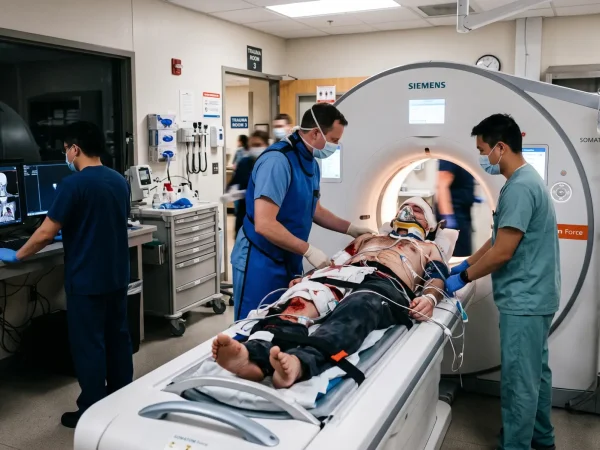
Background: In unstable blunt trauma, whole-body computed tomography (WBCT) is often deferred because the bleeding source is uncertain, potentially delaying definitive hemorrhage control. This retrospective cohort study assessed whether CT-first resuscitation (CTFR)-immediate WBCT in a CT-equipped trauma resuscitation room with prespecified triggers for hemorrhage control-is associated with transfusion, time to hemostatic intervention, and mortality after blunt trauma.
Methods: We conducted a retrospective cohort study (2019-2023) comparing adults managed with CTFR at a single center with patients in the Japan Trauma Data Bank, a national trauma registry. We performed 1:1 propensity score matching (n = 248 per group). The primary outcome was 24-hour red blood cell (RBC) units; secondary outcomes were time to CT initiation, time to first hemostatic intervention (surgical or endovascular), and in-hospital mortality. Sensitivity analyses used multiple imputation.
Results: CTFR shortened the time to CT initiation (median, 0.4 vs. 29.0 min; p<0.001) and time to first hemostatic intervention (median, 53.7 vs. 134.0 min; p<0.001). Any RBC transfusion within 24 hours was similar (29.4% vs. 30.6%; p = 0.845). Adjusted 24-hour RBC units were lower with CTFR (mean difference, -0.84 units; 95% CI: -1.65 to -0.03; p = 0.043). In-hospital mortality was similar (9.7% vs. 8.9%; p=0.877). In an exploratory subgroup of patients presenting with shock, CTFR was associated with a larger reduction in 24-hour RBC units (adjusted mean difference, -3.76 units; 95% CI: -6.44 to -1.09; p = 0.006).
Conclusions: In a matched comparison with a national registry cohort, CTFR was associated with earlier WBCT, shorter time to hemostatic intervention, and modestly lower adjusted 24-hour RBC transfusion requirements, while mortality was similar. These associations appeared more pronounced among patients presenting with shock in exploratory subgroup analyses. (J Trauma Acute Care Surg 2026;00:000-000. Copyright © 2026 Wolters Kluwer Health, Inc. All rights reserved.).
Level of evidence: Therapeutic/Care Management; Level III.
Keywords: Blunt trauma; hemorrhage control; hybrid ER; resuscitation; whole-body computed tomography.